
Issue #05 — March 24, 2026
This week: why mileage-based maintenance is a lie — and what it's costing public works departments in breakdowns and liability.
A fire truck idles for 2 hours at a structure fire. By mileage, it went nowhere. By wear, it aged the equivalent of a 50-mile highway run. Your maintenance software doesn't know the difference.
When that truck's pump seizes mid-call because the service window was missed by a spreadsheet that only tracks odometer miles, the liability is measured in lives — and the lawsuit that follows averages $1.2M per incident.
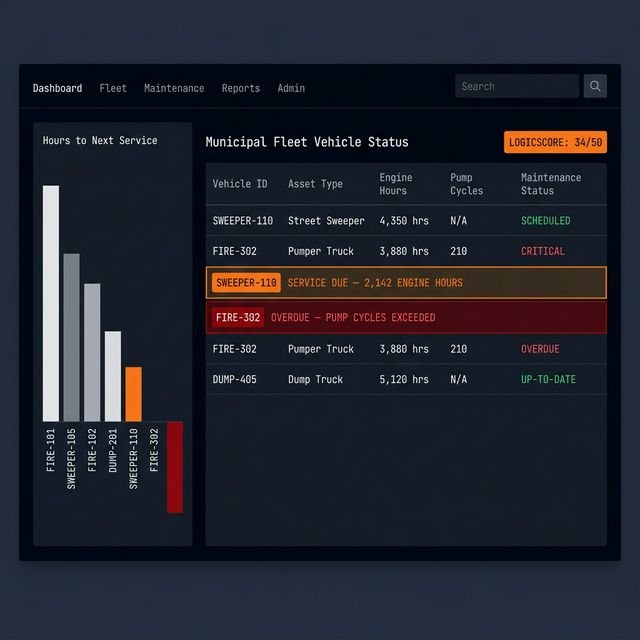
Municipal Asset Maintenance Scheduler — Production MVP Preview
THE TEARDOWN
01 / Who Has This Problem
The Fleet Manager at a municipal public works or fire department managing 20–200 specialized vehicles — fire trucks, street sweepers, ambulances, front loaders. Their maintenance budget is public money. Their failure is public liability.
The average mid-sized city fleet runs 40+ vehicles. Missing a single pump service on a fire apparatus costs $8,000–$40,000 in emergency repair. Missing it twice costs a lawsuit. Most departments track service intervals in Excel, triggered by odometer readings that have zero relationship to actual wear.
02 / Why Existing Solutions Fail
Generic fleet software — Fleetio, Samsara, even municipal ERP systems — is built for delivery trucks and sedans. It triggers service on mileage or calendar date. Neither metric captures the primary wear vectors for specialized municipal equipment: engine idle hours, pump cycles, and vibration load.
A fire truck pumping 1,500 GPM for 3 hours accumulates wear equivalent to 6,000 miles of road use. A street sweeper's brush assembly degrades by vibration cycle count, not distance. These vehicles' service windows are routinely missed by 15–30% when tracked by mileage alone.
03 / The Buildable Solution
A dual-axis trigger scheduler that evaluates engine hours AND pump/vibration cycles independently. Either axis can fire a service alert. The system is asset-aware: a fire truck has different thresholds than a sweeper, and the logic enforces this automatically.
The core logic: if (engine_hours_since_service > threshold OR pump_cycles_since_service > threshold) → SERVICE_DUE. A production MVP is available in the Datum Foundry Vault, including per-asset-type threshold configs and urgency scoring.
04 / Tech Stack
05 / LogicScore
| Pain | 8/10 |
| Frequency | 7/10 |
| Buildability | 6/10 |
| Market | 7/10 |
| Distribution | 6/10 |
🔒 Subscriber Exclusive
Every teardown ships with a production-ready MVP in the Datum Foundry Vault — a private GitHub repository. Subscribe and you get instant access to the full Municipal Maintenance Scheduler, including the dual-axis logic engine, per-asset threshold configs, and the React fleet dashboard.